
As an agency we are often asked in workshops and discussions: "How important is our website to our clients? The origin of this question is not that companies generally question the importance of a website. Everyone knows that a company needs a website and that it should look good.
Rather, the question usually comes from the perspective of salespeople in the B2B sector, where a large proportion of business is (still) done through face-to-face contact. But why digital contact is becoming increasingly important, and how your own website can become the most successful sales representative - who never sleeps or even needs a holiday - can be found in this blog post.
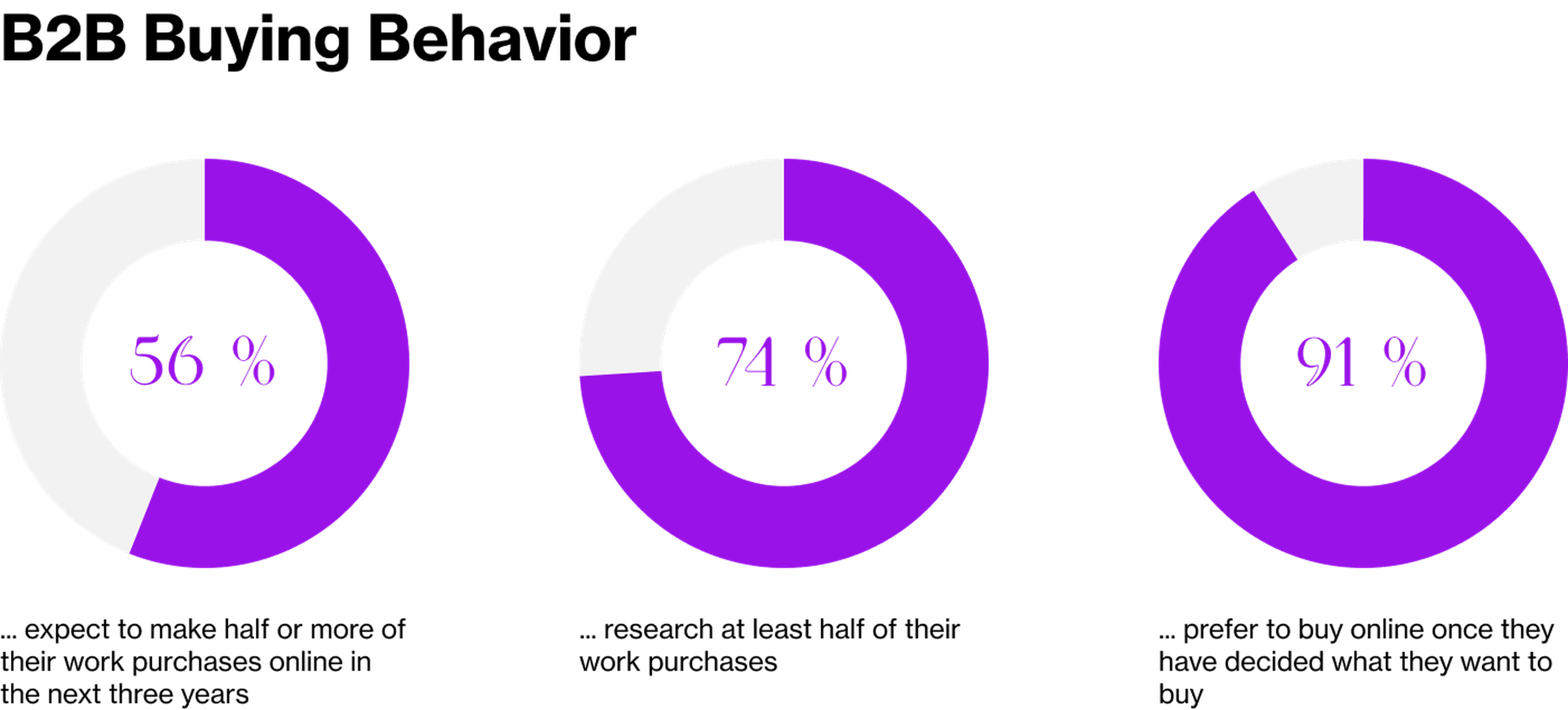
According to business magazine Forbes (cited by UPS, 2019), 10,000 baby boomers turn 65 every day, which means that subsequent generations such as millennials, Generation Y and X are increasingly coming to the fore as buyers. Living in the midst of high-tech has given them a familiarity that makes them experts at using social media channels, mobile apps and internet blogs to research their purchasing decisions. This trend is becoming more prevalent not only in B2C but also in B2B. For B2B buyers, direct face-to-face contact with sales representatives is slowly - but steadily - becoming less important, while digital touchpoints are becoming more important (see Figure 1). One of these important touchpoints is a company's own website. However, simply having a website is not enough to meet the needs of the 'new' buyer. Today, a website must fulfil a number of essential functions. We have summarised these into three key aspects that should be considered when designing a website.
1. Aspect: Traffic generation
Pull communication
Pull communication is about being found by the relevant target audience when they search for the products & services your company offers. Given the research behaviour of the new generation of buyers, a large proportion of them are using search engines such as Google. When a potential customer types in a search term on Google, your website should appear as high up as possible on the search results page. A website that catches potential buyers' searches is doubly important. In addition to the high traffic potential, search queries already have a concrete interest and need, making them particularly valuable from a sales perspective.
There are two main levers to ensure the visibility of your website in the Google network - Search Engine Marketing (SEM) and Search Engine Optimisation (SEO). On the search results page, there are up to four ads above the organic search results that can be occupied with the help of targeted search engine marketing (see Figure 2). To achieve a position in the top tier, i.e. positions one to three, the keyword stored in the SEA campaign and the associated user experience with the respective landing page on the website play a role, among other things.

When it comes to search engine optimisation (SEO), the content of a website is the be-all and end-all when it comes to achieving a good ranking on Google's search results pages. However, focusing on content alone is not enough. The technical side of SEO is also important in achieving a good position in the search network. As a subset of SEO, technical SEO essentially ensures that search engines can easily access, crawl and index a page. This includes measures such as optimising URL structures, adding breadcrumb menus, using structured data, checking canonical URLs, improving page speed, optimising meta tags, being mobile first and using Accelerated Mobile Pages (AMP).
A good content management system (CMS) also plays an important role in ensuring that a website is organically ranked on the first page of the search results. Because SEO is about responding quickly to changing user behaviour, it is important to have an easy-to-use CMS that allows marketing staff to easily modify content. This requires, among other things, WYSIWYG editors and text modules that can be easily moved by dragging and dropping.
Push communication
In addition to adaptations in the area of pull communication, the adaptation of a website to push communication measures is also relevant. Push communication encourages the target group to buy a product or service that they do not yet know about or for which they have yet to develop a need. For this purpose, it is particularly useful to meet the target group where they often spend time. According to the Digital Report, 7.21 million people will be using social media in Austria in 2021 - almost 80% of the total population (We are Social, Hootsuite, DataReportal 2021). Social media channels such as Facebook, Instagram, TikTok or LinkedIn are particularly well suited to creating specific purchase incentives.
If a user clicks on an ad and is successfully redirected to the company's website, the most important information must be provided on a landing page. It is important that the website not only consists of product landing pages, but also has pages with more in-depth information (e.g. in a blog). Especially in the awareness phase of the marketing funnel, such content pages play an essential role. Users should be provided with valuable content so that they stay on the site for as long as possible and, ideally, convert (see aspect 2). However, if a user bounces during the process, remarketing comes into play. Retargeting ads on social media bring a bounced user back to the website and reintegrate them into the customer journey.
2. Aspect: Generating conversions
Once relevant traffic has been brought to the website through pull and push communication, the next step should be to convert it into leads, i.e. to de-anonymise the anonymous website visitors. This can be done by asking for their name, email address or perhaps even additional information such as company or job title. However, there is a trade-off in asking for information: the less information you ask for in a form (e.g. just the email address), the higher the likelihood of conversion - but the less you ultimately know about your website visitors. To decide how much information to ask for in this trade-off, you should test different forms against each other.
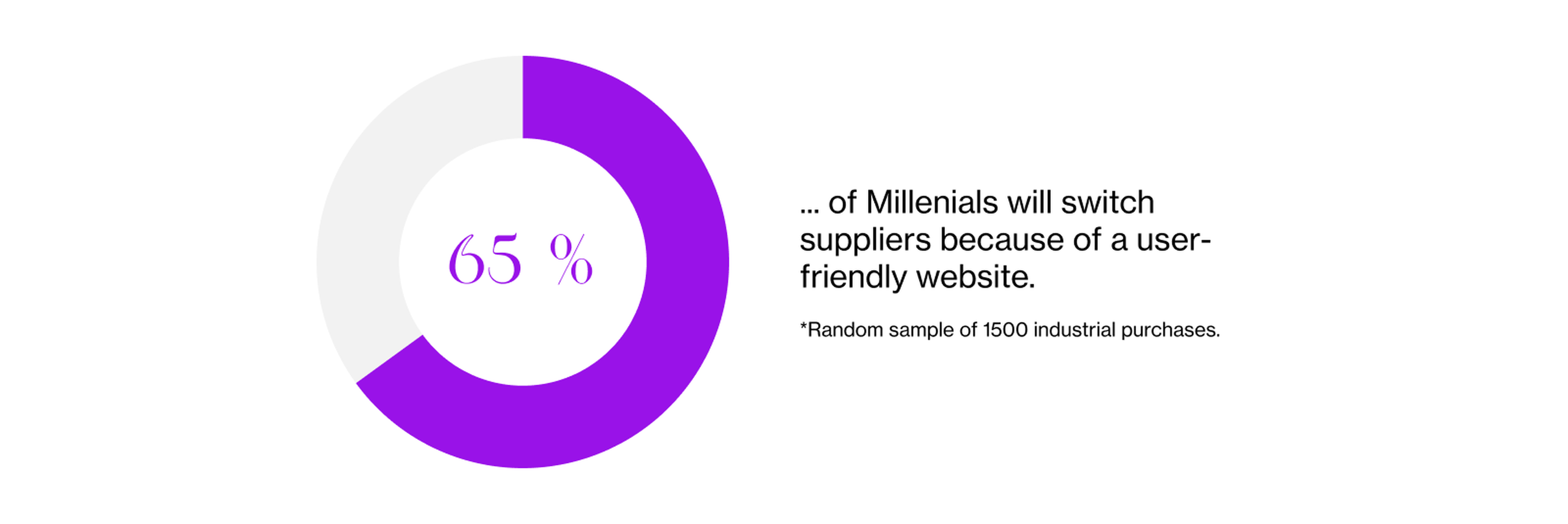
To optimise the conversion rate, there is another aspect to consider: the more interesting the content or service offered, the more likely visitors will be to enter personal information in a form. There are several ways to do this, such as Pay-with-Mail for case studies or a white paper, product or service enquiries, configurators, sample orders, newsletter registrations, event registrations or standard contact forms. But no matter what options you offer your website visitors, it is important that they are able to get to their destination as easily as possible and navigate the site intuitively (see Figure 3). In order to achieve high conversion rates, the website must therefore provide content and services that are as interesting as possible, while at the same time making it as easy as possible to use this content and services in conjunction with a form.
3. Aspect: Marketing Automation and Existing Customer Reactivation
Once the user has been successfully de-anonymised, the next step is marketing automation. Marketing automation is the use of software and tools to standardise, automate, scale and measure digital marketing processes. This software and tools can be used efficiently in conjunction with the website. For example, if a newsletter is distributed via a marketing automation tool, this tool can be integrated into the website via a registration form. Once a user signs up for a newsletter on the website, the newsletters can be sent automatically, without the need for a marketer to add the new contact to a list or start a campaign.
But it's not just about acquiring new customers - coordinated interaction between marketing automation and the website is also essential for cross-selling and up-selling existing customers. When existing customers are repeatedly engaged in their digital worlds, they can be reactivated or encouraged to cross-sell. This can be done, for example, by sending emails to existing customers. If these emails contain content that is relevant to the target audience, they can be linked directly to a landing page with more information. If this content meets the customer's needs and leads to a purchase, the customer's lifetime revenue is increased. This increases the customer lifetime value (CLV). The key to increasing CLV is to have areas of the website specifically designed for existing customers. For example, a separate login area with order history, where orders can be repeated at the click of a button.
Let's summarise once again. No matter where in the digital customer journey your (potential) customers are: Your website is the hub of the customer journey and can become your best sales agent. To achieve this, you should first create the conditions for potential customers to come to your website via social media (push communication) or Google search (pull communication) and return again and again. Second, make sure your website drives as many conversions as possible by providing compelling content combined with easy-to-use features and forms. Last but not least, you should encourage new and existing customers to buy and return to your website by constantly drawing their attention to interesting content and presenting it in an appealing way on your website along the buyer's journey.
Sources
Roland Berger Focus (2018). B2B Marketplaces are blossoming. Abgerufen am 15. April 2021.
UPS (2019). Industrial Buying Dynamics Study. Abgerufen am 15. April 2021.
We are Social, Hootsuite & DataReportal (11. Februar 2021). Anzahl der Internetnutzer und der Social Media-Nutzer in Österreich im Jahr 2021 (in Millionen). Abgerufen am 16. April 2021 von Statista.
🔥 Projects we are proud of
Your turn.